
Your Denver Property May Be Worth More Than You Think: ADU Denver
There is a conversation happening right now in Denver real estate that most homeowners have not had yet. It is about a state law that quietly changed what you are allowed to build on your own property, and what that means for your home’s value, your rental income potential, and your options for multigenerational living.
At Legacy 100 Real Estate Partners, we have been in construction and real estate in the Denver metro for over 50 years. We watched the ADU conversation evolve from a niche zoning discussion into one of the most significant shifts in Colorado residential real estate in a generation. And we are still surprised by how many homeowners have no idea this law exists or what it means for them.
Here is what every Denver homeowner needs to know about ADUs right now.
1. What an ADU Actually Is
ADU stands for Accessory Dwelling Unit. It is a self-contained residential unit located on the same lot as a primary single-family home. It has its own kitchen, bathroom, and sleeping area. It functions as a complete, independent living space.
ADUs come in several forms. A detached ADU is a separate structure on the property, sometimes called a carriage house, backyard cottage, or guest house. An attached ADU shares a wall with the primary home. An interior ADU is created within the existing structure, most commonly a basement conversion. A garage conversion ADU transforms an existing attached or detached garage into living space.
Each type has different cost profiles, zoning requirements, and practical considerations. What they share is the ability to add significant value and flexibility to a property.
For buyers considering a home with an existing ADU or ADU potential, the calculus on affordability changes dramatically. A well-designed ADU generating $1,500 to $2,000 per month in rental income can offset a substantial portion of a mortgage payment. That changes what a buyer can realistically afford and still live comfortably.

2. Colorado’s New Law Changed Everything
In 2024 the Colorado General Assembly passed House Bill 24-1152, a statewide ADU law that rewired the rules for what homeowners in the Denver metro can build on their properties. The law took full effect across most Denver metro jurisdictions by mid-2025.
Here is what it actually means in plain English.
Most single-family lots in the Denver metro area are now required by state law to allow at least one ADU. Cities and counties cannot simply say no. Approval must be administrative, meaning no public hearings, no neighbor vetoes, no discretionary denials by a planning board. The process is supposed to be straightforward and predictable.
The law also addressed HOAs. In subject jurisdictions under HB24-1152, HOA bans on ADUs are unenforceable. If your HOA previously had a blanket rule against adding a secondary unit, that rule no longer has legal force in most cases.
This is a significant shift. For years, the practical and political barriers to building an ADU in many Denver neighborhoods were substantial. Those barriers have been dramatically reduced.
That said, state law sets the floor, not the ceiling. Individual cities still control design standards, setback requirements, height limits, and other details. Denver itself has one of the most mature ADU frameworks in Colorado, with specific zoning rules that vary by district. Checking your specific property’s zoning before making any plans is still an essential first step.
3. What an ADU Could Mean for Your Home’s Value
This is where the conversation gets interesting for homeowners and buyers alike.
A well-designed ADU adds value in two distinct ways. The first is straightforward rental income. A finished basement ADU or backyard cottage in Lakewood or Littleton can realistically generate $1,200 to $2,000 per month depending on size, finish level, and location. Over the course of a year that is $14,400 to $24,000 in additional income from a property you already own.
The second value driver is appreciation. Homes with existing ADUs, or with lots that clearly support ADU construction, are commanding premiums in the current Denver market. Buyers who understand the income potential or the multigenerational living options are willing to pay more for that flexibility. As awareness of the new law grows, that premium is likely to increase.
For sellers, a property with an existing ADU or documented ADU potential is a different listing conversation than a standard single-family home. It opens the door to investors, to buyers who want to offset their mortgage, and to multigenerational families looking for space that works for everyone.
For buyers, identifying properties with ADU potential is a skill that can meaningfully change the affordability calculus on a Denver purchase. Our Denver real estate investment guide covers how to think about income-producing properties in the metro in more detail.
4. What It Actually Costs to Build an ADU in Denver
This is the question everyone eventually asks, and the answer is wide-ranging depending on the type of ADU and the specifics of the project.
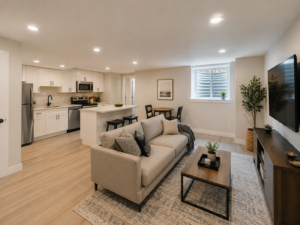
A basement conversion ADU is typically the most cost-effective option for homeowners who already have an unfinished or partially finished basement. Depending on the scope of work, egress requirements, and finish level, costs generally range from $75,000 to $150,000 in the current Denver construction market. This is the option Jim’s builder background leads us to recommend most often as a starting point for homeowners who want to test the ADU waters without building from scratch.
A garage conversion is similarly cost-effective, often in the $50,000 to $120,000 range depending on whether the structure needs significant upgrades to meet residential building codes.
A detached ADU built from the ground up is the most expensive option, typically ranging from $150,000 to $300,000 or more depending on size, design, and site conditions. The costs are higher but so is the potential rental income and the flexibility of having a completely separate structure.
Permit costs, utility connections, and design fees add to these figures and vary by municipality. Denver has a specific permitting process for ADUs that is worth understanding before breaking ground.
One note from our construction experience: ADU costs in the Denver market have remained elevated since the post-pandemic materials and labor increases. Budgeting conservatively and getting multiple contractor bids is essential. The cheapest bid is not always the right bid, particularly for work that will affect the long-term value of your property.
5. ADUs and Multigenerational Living
This is a dimension of the ADU conversation that gets less attention than the rental income angle but is equally important for many Denver families.
Colorado’s Front Range is home to a significant and growing population of older adults, many of whom want to remain close to family while maintaining their independence. An ADU on a family member’s property can provide exactly that; a separate living space with shared access to family, yard, and support systems.
For adult children caring for aging parents, an ADU eliminates the impossible choice between assisted living and a cramped guest room. For grandparents who want to be near grandchildren without living under the same roof, it offers real independence. For multigenerational families navigating the Denver housing market together, it can make an otherwise unaffordable situation workable.
Our team understands this dimension of the ADU conversation at a deeper level than most brokerages. We have a broker on our team who holds a master’s degree in gerontology, and the intersection of housing, independence, and aging is something we think about seriously. If multigenerational living is part of your ADU consideration, we would be glad to talk through what that looks like in practice.
Our downsizing guide also touches on how ADUs fit into the broader picture of right-sizing for Denver families at different life stages.
6. What to Ask Before You Buy or Build
Whether you are a current homeowner considering adding an ADU or a buyer evaluating a property for its ADU potential, here are the questions that matter most before you commit to anything.
Is the property in a subject jurisdiction under HB24-1152? Most Denver metro properties are, but it is worth confirming. Your broker or the relevant municipality can tell you quickly.
What does the specific zoning allow? Denver’s zoning code governs setbacks, height limits, lot coverage, and other design standards that will shape what is actually buildable on a given property. The Denver Community Planning and Development office is the authoritative source here.
Does the lot have the physical characteristics to support the ADU type you want? Lot size, existing structures, utility access, and topography all affect feasibility. A property that looks ideal on paper may have site conditions that complicate or significantly increase the cost of ADU construction.
If there is an existing ADU, has it been permitted? Unpermitted ADUs are a significant risk for buyers. An unpermitted unit may need to be brought up to code at substantial cost, or in some cases may need to be removed. Always verify permit status before closing on a property with an existing secondary unit.
What is the realistic rental income for this specific location? Rental rates vary considerably across the Denver metro. A basement ADU in one neighborhood may generate significantly more or less than the same unit in another. Understanding local rental dynamics before you build or buy is essential to making the math work.
These are exactly the kinds of questions the team at Legacy 100 Real Estate Partners works through with clients every day. Our construction background means we can look at a property and assess ADU potential in a way that most brokers simply cannot. And our knowledge of the Denver metro means we can tell you honestly whether the numbers make sense for a specific property in a specific location.
If you are curious about what ADU options might exist for your current home, or if you are searching for properties with strong ADU potential in Lakewood, Littleton, or anywhere in the Denver metro, we would love to have that conversation.
Our experience. Your legacy.
Contact Legacy 100 Real Estate Partners to talk through your ADU options in Denver.

Related reading:
- Denver Real Estate Investment: 5 Critical Things Smart Investors Need to Know
- Downsizing Your Home in Denver: 7 Surprising Things Nobody Tells You
- Denver Colorado Real Estate Taxes: The Critical 2026 Guide
- How Much Does It Cost to Sell My House in Denver?
- Denver Neighborhood Guide: Finding the Right Fit in 2026
External Links:
- Colorado HB24-1152 ADU law overview: https://dlg.colorado.gov/accessory-dwelling-units
- Denver Community Planning and Development ADU information: https://www.denvergov.org/Government/Agencies-Departments-Offices/Agencies-Departments-Offices-Directory/Community-Planning-and-Development/Denver-Zoning-Code/Text-Amendments/Citywide-ADUs