
Every month I get the latest numbers from REcolorado, and every month I share them with clients because I believe informed buyers and sellers make better decisions. The April 2026 Denver metro area data just came in and it tells a really interesting story about where this market actually is right now.
Not the sensational headline version. The real version.
Let me break it down.
The Numbers at a Glance
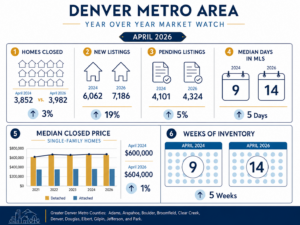
Here is what REcolorado reported for the Greater Denver Metro Area in April 2026, covering Adams, Arapahoe, Boulder, Broomfield, Clear Creek, Denver, Douglas, Elbert, Jefferson, Gilpin, and Park Counties:
Homes closed: 3,982 vs 3,852 in April 2025, up 3%
New listings: 7,186 vs 6,062 in April 2025, up 19%
Pending listings: 4,324 vs 4,101 in April 2025, up 5%
Median closed price for single-family homes: $604,000 vs $600,000 in April 2025, up 1%
Median days in MLS: 14 days vs 9 days in April 2025, up 5 days
Weeks of inventory: 14 weeks vs 9 weeks in April 2025, up 5 weeks
What This Data Actually Means
I want to take each of these numbers and give you the real-world interpretation, because raw data without context is almost meaningless.
More Homes Coming to Market
New listings jumping 19% year over year is the biggest headline in this report. Nearly 1,200 more homes hit the Denver market in April 2026 than in April 2025. That is a significant increase in supply and it is the primary reason buyers are experiencing a different market than they did two or three years ago.
More listings means more choices, more time to think, and more negotiating leverage for buyers. For sellers, it means more competition. The days of listing a home and watching five offers appear by Sunday evening are largely behind us in most price ranges and neighborhoods.
Buyers Are Still Buying
Despite all the noise about high mortgage rates and affordability challenges, closed sales were actually up 3% year over year. Nearly 4,000 homes closed in the Denver metro in April 2026. That is not a market in distress. That is a market where people are making decisions, moving forward, and getting deals done.
Pending listings up 5% reinforces this. There is genuine buyer demand in the Denver residential real estate market right now. The buyers who are moving forward are doing so thoughtfully and with more leverage than they had in 2022, but they are moving.
Prices Are Holding Steady
This is the number that surprises most people when I share it: the median closed price for a single-family home in the Denver metro was $604,000 in April 2026, up just 1% from $600,000 a year earlier.
After years of dramatic appreciation, Denver home prices have essentially plateaued into a stable, sustainable range. That 1% increase is actually very healthy. It means sellers are not losing equity. It means buyers are not buying into a bubble. It means the market has found a natural equilibrium.
For anyone who has been sitting on the sidelines waiting for prices to crash, this data is worth paying attention to. Prices are not crashing. They are holding firm with modest appreciation. The window of dramatically lower prices that some buyers have been waiting for does not appear to be coming.
Homes Are Taking a Little Longer to Sell
Median days in MLS moving from 9 to 14 is probably the most significant shift for sellers to understand. Homes are sitting on the market about five days longer on average than they were a year ago.
Five days does not sound like much, but it represents a meaningful psychological shift. In 2022, a home that had not received an offer within the first weekend was considered stale. Today, 14 days is perfectly normal. Buyers are taking more time to think, visit multiple properties, and make considered decisions.
What this means for sellers: pricing accurately from day one matters more than ever. A home that launches at the right price and shows well is still generating strong interest. A home that launches too high and sits for three or four weeks starts to develop a stigma that is hard to recover from, even with a price reduction.
Inventory Has Built Up Significantly
Weeks of inventory moving from 9 to 14 tells the same story as the listings data from a different angle. There is more supply relative to demand than there was a year ago. Fourteen weeks of inventory is approaching balanced market territory in most segments.
The exception worth noting: the attached market, meaning condos and townhomes, continues to carry significantly more inventory than the single-family segment. If you own a condo or townhome and are thinking about selling, working with an agent who understands how to position and price in that specific segment is more important than ever.
What This Means If You Are Thinking About Buying
The Denver residential real estate market in spring 2026 is genuinely one of the more favorable environments for buyers in recent years. Here is why:
You have choices. With inventory up significantly, you can be selective in a way that simply was not possible in 2021 or 2022. You have time to do proper due diligence, get thorough inspections, and make thoughtful decisions.
You have negotiating power. Sellers are more willing to consider concessions, including rate buydowns, closing cost credits, and repair allowances, than they have been in years. That additional leverage can translate to thousands of dollars in savings.
Prices are not falling but they are not running away either. The 1% appreciation we saw year over year means you are not buying at the bottom of a market about to crash, but you are also not watching prices accelerate away from you while you wait.
(Read our complete guide to buying a home in Denver ->)
What This Means If You Are Thinking About Selling
The market is workable for sellers who go in with the right strategy and realistic expectations. Here is the honest picture:
Pricing is everything right now. With inventory up and buyers taking more time, an overpriced home will sit. And a home that sits loses leverage fast. A well-priced home in good condition in a desirable neighborhood is still generating strong buyer interest and closing at or near list price.
Presentation matters more than it did two years ago. When buyers have options, they gravitate toward the homes that show the best. Professional photography, clean presentation, and addressing obvious deferred maintenance before listing are more important now than when buyers were competing for any available home regardless of condition.
The condo and townhome market requires extra attention. If you own attached housing and are thinking about selling, have a candid conversation with your agent about realistic timelines and pricing strategy. That segment is carrying the most inventory and requires the most sophisticated approach.
(Read our complete seller’s guide for Denver homeowners ->)
The Bottom Line
The Denver residential real estate market in spring 2026 is not a seller’s market and it is not a buyer’s market. It is a balanced market that rewards preparation, realistic expectations, and good local guidance on both sides of the transaction.
Buyers who are prepared and decisive are finding good homes at fair prices. Sellers who price correctly and present their homes well are closing successfully. The chaos of the pandemic era is behind us, and what we have now is a healthier, more sustainable version of the Denver market that has always attracted people from across the country.
At Legacy 100 Real Estate Partners, we have navigated every kind of Denver market over the past 40 years. Whether you are buying, selling, or just trying to understand where things stand, we are always happy to share what we are seeing on the ground.
Questions about what this data means for your specific situation? Reach out to our team anytime ->
Source: REcolorado Denver Metro Area Year Over Year Market Watch, April 2026 REcolorado April 2026 Market Data Denver Metro Association of REALTORS