
Seller Concessions, Denver 2026
If you have been wondering whether there is real room to negotiate in the Denver real estate market right now, the Q2 2026 data from REcolorado just answered that question with unusual clarity.
Nearly two out of three homes that closed in the Denver metro between April and June 2026 included a seller concession. Not a handful of desperate sellers. Not a few outlier transactions. 62.9% of all residential closings across Adams, Arapahoe, Boulder, Broomfield, Clear Creek, Denver, Douglas, Elbert, Gilpin, Jefferson, and Park counties included some form of seller concession, with a median concession of $10,000.
In total, more than $81.49 million was given back to buyers during Q2 2026 alone.
This is not a buyer’s market in the dramatic crash sense that headlines sometimes imply. Homes are still selling. Prices are still positive year over year in most segments. But it is a negotiation-driven market in a way that Denver has not seen since before the pandemic, and the buyers and sellers who understand the data are going to make significantly better decisions than the ones who do not.
Here is what the numbers actually say.
What Is a Seller Concession and Why Does It Matter?
A seller concession is money the seller contributes toward the buyer’s costs at closing. It is not a price reduction, and that distinction matters more than most people realize.
Concessions can take several forms. Closing cost credits reduce the cash a buyer needs to bring to the table at closing. Repair credits address inspection findings without requiring the seller to manage contractor work. And interest rate buydowns, the most valuable concession type in the current data, use seller money to permanently or temporarily reduce the buyer’s mortgage rate.
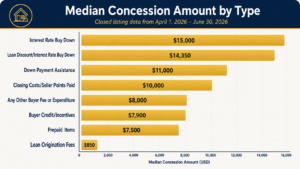
In Q2 2026, interest rate buydowns topped all concession types with a median value of $15,000, according to REcolorado data. That is $15,000 of seller money going directly toward reducing a buyer’s monthly payment for the life of the loan. Loan discount and interest rate buydown combinations came in at $14,350. By contrast, loan origination fee credits averaged just $850, well below every other category.
For buyers, understanding which concession type actually serves you best in your specific situation is one of the most valuable conversations to have with your broker before you make an offer. A $10,000 closing cost credit and a $10,000 rate buydown are not the same thing. One reduces your upfront cash. The other reduces your monthly payment permanently. Which one matters more depends entirely on your financial situation and how long you plan to stay in the home.
What the Data Says About Price Reductions
Concessions are only part of the Q2 2026 story. Price reductions are the other half and the data there is equally revealing.
Among Denver metro listings that experienced at least one pricing event in Q2 2026, the median price reduction was $25,000. The median below-list close, meaning the seller accepted an offer below their final asking price, was $15,000. And as noted, the median concession was $10,000.
But those numbers only tell part of the story. The more interesting data is what happens over time.
In the first seven days on market, 48% of listings experienced seller concessions only. Sellers were using concessions as a first-line tool to attract buyers without touching the list price. That makes sense since a rate buydown is less visible to subsequent buyers than a price reduction and does not signal distress the way a price cut sometimes can.
As days on market accumulated, the picture shifted dramatically. Listings experiencing all three events- a price reduction, a below-list sale, and a seller concession, increased from essentially zero in the first seven days to 28% by 50-56 days on market. And the average price cut at that 50-56 day mark reached $28,278, more than twelve times the $2,321 average for listings on market just 8-14 days.
The practical takeaway is significant. Sellers who price correctly from day one and use concessions strategically early are transacting efficiently and controlling the narrative. Sellers who overprice and wait are eventually making much larger concessions under much less favorable conditions.
What This Means If You Are a Buyer
The Q2 2026 data is the clearest picture we have seen in years of what is actually available to prepared Denver buyers right now.
Two out of three sellers are willing to give something back at closing. The question is not whether you can negotiate, it is whether you know how to negotiate effectively and what to ask for.
A few things the data tells prepared buyers:
Start early. The biggest concessions and the best negotiating dynamics happen after day 29, but you do not have to wait for a listing to sit. A correctly priced home that has been on the market for two weeks with a motivated seller can be just as negotiable as a stale listing, especially if you come in with a strong pre-approval and clean terms.
Ask for a rate buydown. With rate buydowns topping all concession types at a $15,000 median, this is where the real value is in the current market. A permanent rate buydown reduces your payment for the life of the loan. On a $600,000 mortgage, even a half-point rate reduction saves roughly $175 per month or more than $60,000 over a 30-year loan. That is significantly more valuable than the same dollar amount applied to closing costs.
Do not confuse concessions with price reductions. They serve different purposes and affect your bottom line differently depending on your down payment, your financing, and your timeline. Your broker should be helping you model both scenarios before you decide what to ask for.
Look at homes with days on market. Our days on market post made this case from a psychological perspective. The Q2 data makes it in dollars. A listing at day 50 has an average price cut of $28,278 already built in and is statistically far more likely to involve a below-list close and additional concessions. The home that everyone scrolled past two weeks ago may be significantly more negotiable today.
What This Means If You Are a Seller
The Q2 2026 data is not bad news for sellers. It is information that, used correctly, leads to better outcomes.
The sellers who are transacting efficiently in this market share a few characteristics. They priced based on current comparable sales, not 2022 peak values or what they need to net. They prepared the home well before listing. And they used concessions strategically and early, particularly rate buydowns, rather than waiting until a price reduction became unavoidable.
The data makes the cost of overpricing very clear. A seller who starts too high and sits for 50-56 days is averaging a $28,278 price cut, more than twelve times what a seller who priced correctly and used an early concession might have given up. The math almost always favors getting it right from day one.
A few specific things sellers should understand from this data:
Concessions are now standard, not a sign of weakness. When 62.9% of all closings include a seller concession, offering one is not a distress signal, it is how this market works. Buyers expect it and budget for it. Fighting the expectation costs more than meeting it.
Rate buydowns work better than most sellers expect. A $10,000-$15,000 rate buydown can make a home affordable for a buyer who would otherwise be priced out, without requiring a price reduction that affects your net proceeds in the same way. It is worth discussing with your broker before you default to a price cut.
The combination of all three events is expensive. When a listing sits long enough to accumulate a price reduction, a below-list close, AND a concession, which happened to 28% of listings by day 50-56 in Q2, the seller has given up significantly more than any of those events would have cost individually if deployed strategically from the start.
For more on pricing strategy and what buyers are expecting in the current market, our selling FAQ and our post on why your house might not be selling cover the full picture.

The Legacy 100 Take
We have been saying for months that Denver has returned to a market where fundamentals matter again. The Q2 2026 REcolorado data puts specific dollar amounts on what that means in practice.
Buyers have real negotiating power for the first time in years. Sellers who understand the market they are actually in rather than the one from 2021 are transacting successfully. And the gap between sellers who price and present well and sellers who do not has never been more measurable.
This is the market we are navigating with our clients every day. If you want to understand what the numbers mean for your specific situation, whether you are buying, selling, or trying to figure out which direction makes more sense right now, that is exactly the conversation we are here to have.
Our experience. Your legacy.
Contact Legacy 100 Real Estate Partners to talk through what the Q2 2026 data means for you.
Related reading:
- Days on Market in Denver: Why the Home Everyone Is Ignoring Might Be the Opportunity You’ve Been Waiting For
- Selling a Home in Denver in 2026: The Questions Every Seller Is Actually Asking
- Buying a Home in Denver in 2026: The Questions Every Buyer Is Actually Asking
- Denver Real Estate Market Update: May 2026
- Why My House Is Not Selling: 8 Honest Reasons and How to Fix Them
External Links:
- REcolorado Q2 2026 Price Reductions and Seller Concessions Report: https://recolorado.com/price-reduction-q2-2026/
- Colorado Division of Real Estate consumer resources: https://dre.colorado.gov/consumers