
Selling Your Home After a Loss
If you are reading this, something significant has probably happened in your life. A death. A divorce. A diagnosis. A child leaving home. One of those events that divides your life into before and after.
And somewhere in the middle of trying to process all of that, you are also wondering what to do about your home.
We want to talk to you about that. Not as brokers trying to make a sale. As people who have sat in a lot of living rooms with families in exactly this moment, and who have learned over decades what helps and what hurts.
Our honest advice, most of the time, is to wait.
Here is why and here is when waiting is not the right answer.
What Grief Does to Decision-Making
This is not just an emotional observation. It is grounded in real science.
Grief triggers a neurological fight or flight response. When we experience profound loss, our nervous system activates the same survival mechanisms that evolved to help us escape physical danger. The result is a powerful urge to DO something to change our environment, to escape what feels unbearable, to create distance between ourselves and the source of pain.
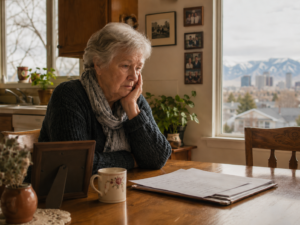
Your home, full of memories of the person you lost, can feel like the source of that pain. The bedroom where they slept. The chair they always sat in. The kitchen where you made coffee together every morning for thirty years. The impulse to leave to put all of that behind you and start somewhere new is not irrational. It is deeply human.
But it is fight or flight talking. And fight or flight is not known for its long-term planning.
What We Have Seen
We have been in this business for over fifty years and we have sat with families in this moment more times than we can count. Here is what we have observed.
The memories that feel unbearable right now the ones that make you want to leave immediately are usually the same memories that become precious with time. The painful reminder of the person you lost almost always softens, with enough time, into something closer to comfort. The house that feels haunted in the first year of grief often becomes the place where you feel most connected to the person who is gone.
We have watched people sell their homes in the immediate aftermath of a death and regret it deeply once the acute grief softened. Once you are gone, you cannot go back. The new owners painted over the wall where you marked your children’s heights. They changed the garden your husband tended for twenty years. The house that held your whole life belongs to someone else now, and the decision that felt urgent and necessary at the time looks different from the other side of it.
We have also watched people hold on too long when selling was clearly the right thing to do.
The difference, in our experience, almost always comes down to this: are you running away from pain, or moving toward something? Those are very different decisions and they tend to produce very different outcomes.
The Outside Pressures That Can Push You the Wrong Way
This is the part we talk about carefully because it is real and it is important.
Not everyone around a grieving person has their best interests at heart. We have seen adult children begin emptying a parent’s home before the surviving spouse has had time to process what happened. We have seen family members push for a quick sale because of inheritance considerations that have nothing to do with what the surviving spouse actually needs. We have seen well-meaning friends insist that a fresh start somewhere new is exactly what a grieving person needs when what the grieving person actually needs is time and support, not a moving truck.
If you are feeling pressure from the people around you to make a real estate decision quickly, that pressure deserves scrutiny. Whose interests does the urgency actually serve?
A broker who will sit with you, listen to your situation without an agenda, and help you figure out what is right for YOU not what is convenient for the people around you is a very different thing from a broker who shows up ready to list.
We are the first kind. We have ended conversations with family members on behalf of clients who needed someone in their corner. We take the fiduciary duty seriously and it does not stop at the contract.
The Financial Reality: When Waiting Has a Cost
If you are a surviving spouse, you have a two-year window after your spouse’s death during which you can sell your home and use the full married filing jointly capital gains exclusion $500,000 of gain excluded from federal taxes. After that two-year window closes, you revert to the single filer exclusion of $250,000.
In a Denver market where homes have appreciated significantly over the past decade, the difference between those two exclusions can be enormous. A home purchased for $300,000 that is now worth $900,000 has $600,000 in gain. Sell within two years of your spouse’s death and $500,000 of that is excluded. Wait until year three and only $250,000 is excluded meaning you could owe taxes on an additional $250,000 of gain.
This is exactly why we recommend talking to both a broker AND a CPA when you are in this situation. Our general advice is to wait but the financial picture is specific to your situation and sometimes the right emotional decision and the right financial decision are not pointing in the same direction. Understanding both sides of that equation, with qualified professional guidance, is how you make a decision you can live with.
We also recommend our post on when to hire a real estate attorney or CPA for more on when professional tax and legal counsel matters in a real estate transaction.
Our Advice: Wait a Year If You Can
The general guideline we give to families in grief is to wait a full year before making a major real estate decision if at all possible.
A year is not arbitrary. It takes most people through the first full cycle of significant dates the first birthday without them, the first holidays, the first anniversary and those experiences matter. They change how you feel about the spaces where you shared those moments. They give you information about who you are becoming in this new chapter that you simply do not have in the first weeks and months.
A year also gives you time to figure out who you are and what you actually want separate from what grief is telling you. Do you actually want to move to be closer to your children, or does that just feel like the safest option right now? Do you actually want to downsize, or does the empty house just feel overwhelming right now? These are questions worth sitting with before you make a decision that cannot easily be undone.
We are happy to come and sit with you. To listen. To talk through what you are feeling and what you are considering. To help you separate what grief is asking for from what your actual future self might need. That conversation costs nothing and we do not bring a listing agreement with us when we come.
When you are ready if you decide to move at all we will be there. But we will never try to talk you into a sale you are not ready for. That is not what we do.

When Moving Quickly Might Actually Be Right
We want to be fair to the other side of this.
Sometimes a quick move after a loss IS the right decision. A surviving spouse who cannot physically maintain a large home alone. A situation where the financial reality of the estate requires liquidation. A case where the surviving partner genuinely has a clear plan and a place to go that they had already been considering before the loss. A situation where staying in the home is genuinely retraumatizing rather than healing.
We have worked with people who made the decision to move quickly and it was clearly the right call. The difference is usually that the decision came from a clear-eyed assessment of their actual circumstances rather than from the fight or flight impulse to escape painful feelings.
The question we ask is: in a year, when the acute grief has softened somewhat, do you think you will be glad you made this decision? If the honest answer is yes not because the pain will be gone but because the move genuinely makes sense for your life then moving forward may be right.
If the honest answer is “I have no idea, I just cannot be here right now” that is usually a signal to wait.
To the Family Who Is Moving Right Now
If you are the family who has already decided who is in the middle of a move right now, or who has made up their mind and is not looking for permission to change it this post is not meant to second-guess you.
Every situation is specific. Every grief is its own. And you know things about your life and your circumstances that no blog post can account for.
What we want you to know is that if you made this decision in the fog of the hardest time of your life, and someday you wonder whether it was the right one that wondering is normal. It does not mean you were wrong. It means you are human, and that you made the best decision you could with what you had at the time.
And if you need someone to talk to about a real estate decision you are facing now or someday we are here. Not to sell you something. To help you figure out what is right.
That is what we do.
Our experience. Your legacy.
Related reading:
- The Real Estate Transactions Nobody Prepares You For
- Downsizing Your Home in Denver: 7 Surprising Things Nobody Tells You
- Do I Need a Real Estate Attorney in Colorado?
- Selling a Home in Denver in 2026: The Questions Every Seller Is Actually Asking
- Who Should I Hire to Sell My House in Denver?
External Links:
- IRS Publication 523 Selling Your Home (capital gains exclusion for surviving spouses): https://www.irs.gov/publications/p523
- Colorado Department of Revenue capital gains information: https://tax.colorado.gov