
Denver real estate market update September 2026
Every month we pull the latest data for the Denver metro and give you the honest interpretation. This month the honest interpretation requires a moment of acknowledgment before we get into the numbers.
September 2026 was a significant month in Denver real estate. Not catastrophic. Not a crash. But significant — and worth understanding clearly if you are buying, selling, or trying to make sense of what is happening.
Here is what the data says and what it actually means.
The Numbers at a Glance
Here is what DMAR reported for the Greater Denver Metro Area in September 2026, sourced from REcolorado MLS data:
Closed listings: 2,849 — down 21.39% from September 2025 and down 11.71% from August 2026
Pending listings: 2,908 — down 6.07% from August 2026
Active inventory: 13,567 listings — 4.76 months of supply
Median days in MLS: 32 days — down from 35 days in September 2025
Close-price-to-list ratio: 98.45% — up slightly from 98.32% last September
30-year fixed mortgage rate: climbed to approximately 7.5% by end of September
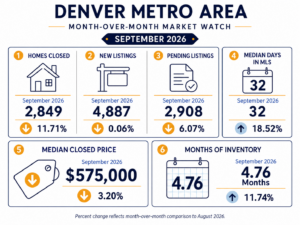
Info based on DMAR Real Estate Market Trends Report, September 2026
The Headline Nobody Wanted: Fewest September Closings Since 2008
Let us say it plainly. September 2026 produced the fewest September closings on record dating back to 2008 — the height of the financial crisis. That is a number worth sitting with.
But context matters enormously here, and the context is important.
Most homes that closed in September went under contract in August, when rates were still hovering around 6.7 percent. The dramatic rate move happened in September itself — the 30-year fixed climbed each week, reaching approximately 7.5 percent by month’s end. The full impact of that rate climb has not yet shown up in closing data. It will show up in October and November numbers, and softer data ahead would not be surprising.
The other context worth noting: year-to-date closings trail 2025 by only 4.96 percent. Despite a rough September, the cumulative gap for the year is not as dramatic as a single month’s number suggests. And the year-to-date median close price for detached homes is $650,000 — matching each of the past two years almost exactly. Prices are holding even as volume has declined.
The Fed Did Something Nobody Expected
Mid-September, the Federal Reserve raised the federal funds rate for the first time since July 2023.
Anyone who had been waiting for rates to come down and make buying more affordable just watched that scenario become significantly less likely in the near term. The 30-year fixed rate, which had been hovering around 6.7 percent through the summer, climbed to approximately 7.5 percent by the end of the month.
This changes the conversation around buying and selling in meaningful ways. Rate buydowns — where the seller contributes money to permanently or temporarily reduce the buyer’s rate — become even more valuable in this environment. Adjustable rate loans are worth exploring for buyers who plan to sell or refinance within a specific timeframe. And the negotiation conversation has shifted: sellers who build rate concessions into their pricing strategy will find buyers who are ready to move.
What Is Actually Selling — And Selling Fast
Here is the part of the September data that almost nobody is talking about.
While the broader market slowed dramatically, Denver’s luxury segment — homes priced at $1 million and above — is outperforming every other price tier.
Year-to-date, closings in the $1 million+ segment are up 1.99 percent, with 4,449 closed sales and $7.30 billion in sales volume — barely shy of the 2022 peak. In September, new listings in this segment jumped 12.15 percent month-over-month, suggesting increased seller confidence. And $1 million+ listings spent a median of just 21 days in MLS in September, compared with 32 days across the broader market.
Detached luxury homes moved even faster — a median of 19 days.
This is not a random signal. The buyers who can afford $1 million+ homes are less affected by rate increases. Their purchasing decisions are driven more by lifestyle, timing, and value than by the monthly payment math that rate changes impose on mid-market buyers. And right now, they are buying.
The highest-priced September sale was 31 Albion Place in Castle Rock — over 10,000 square feet, sold for $7.4 million in cash after 44 days. The highest attached sale was in Cherry Creek North at 500 Adams Street, which sold for $4.3 million in cash.

The Attached Market Is the Hardest Hit
If there is a segment of the Denver market that deserves serious attention right now, it is condos and townhomes.
The attached segment has 7.21 months of inventory — well into buyer’s market territory. The median close price for attached properties is $365,500, down 6.28 percent year over year. And median days in MLS for attached properties stretched to 45 days in September.
For buyers who have been priced out of the detached market, this represents a genuine opportunity window. For sellers of condos and townhomes, pricing with HOA fees and insurance costs in mind — factors that buyers are calculating very carefully in the current environment — is essential.
The attached market’s struggles are partly structural. Rising HOA fees, elevated insurance costs, and the specific financial scrutiny that lenders apply to condo buildings have made the financing conversation more complicated for attached properties. Understanding those dynamics before listing is critical.
What This Means for Buyers
The September data, combined with the rate increase, creates a complicated picture for buyers — but not a discouraging one if you understand it correctly.
The inventory picture is the most buyer-friendly it has been in years. With 4.76 months of supply overall and 7.21 months in the attached segment, buyers have real choices, real time to make decisions, and real negotiating leverage. The close-price-to-list ratio of 98.45 percent means homes are selling very close to asking price — but that asking price is being set in a market where sellers know they need to compete.
The rate reality is the harder conversation. At 7.5 percent on a 30-year fixed, the monthly payment on a $600,000 loan is approximately $4,196 — meaningfully higher than it was six months ago. Rate buydowns, seller concessions, and adjustable-rate structures are all legitimate tools worth exploring with your lender.
The DMAR Market Trends Committee put it well: “Active listings typically taper through the fourth quarter, and some sellers will pull their homes for the holidays. Buyers who remain in the market will face less competition than at any other time of year.”
October and November are historically among the least competitive months for buyers in the Denver market. The buyers who keep moving while others wait for the new year tend to find the best opportunities.

What This Means for Sellers
September’s numbers require sellers to be clear-eyed about the market they are actually in.
The fewest September closings since 2008 is not a headline that can be dismissed. Buyers are cautious. The rate increase has reduced the pool of financially qualified buyers at every price point below $1 million. And with 13,567 active listings, your home is competing against a significant number of other options.
What the data also shows is that the homes that are selling are selling efficiently. A 98.45 percent close-price-to-list ratio and a 32-day median days in MLS are not the statistics of a broken market — they are the statistics of a market where correctly priced, well-presented homes are still transacting.
The sellers who are struggling are the ones priced above where the market is trading, in a market where buyers have enough options to simply move on. The sellers who are succeeding have accepted the current reality, priced accordingly, and in many cases built rate concession strategies into their approach.
If you are thinking about selling, the fourth quarter conversation is nuanced. Inventory typically drops through November and December as sellers pull listings for the holidays — which means fewer competing options for your home. The buyers who remain active in the market in October and November are serious, motivated buyers who are not going to pause for the holidays. That is a specific and valuable audience.
The Consistent Market Underneath the Noise
Here is the longer view that DMAR’s data reveals and that we find genuinely reassuring.
Since 2023, year-to-date closings have stayed within roughly six percent of one another across each year. The year-to-date median close price has stayed within about three percent. The market has absorbed multiple rate spikes, a Fed rate hike, and dramatic month-to-month swings — and prices have held.
Denver’s fundamentals — population growth, job market strength, quality of life, geographic desirability — have not changed. The market is slower. It is harder. Buyers and sellers are navigating real challenges. But it is not collapsing, and the underlying value proposition of Denver real estate remains intact.
We have been selling in this market through every cycle since the 1980s. We have seen rate spikes, market slowdowns, and moments that felt dramatic at the time and look like footnotes in retrospect. September 2026 is a significant data point. It is not the end of the story.
We will be back with the October numbers as soon as the data is released.
In the meantime, if you have questions about what September’s data means for your specific situation — whether you are buying, selling, or trying to figure out which direction makes more sense right now — that is exactly the conversation we are here to have.
Our experience. Your legacy.
Related reading:
- Denver Real Estate Market Update: August 2026
- Is It a Good Time to Buy a House in Denver?
- Price Reductions and Seller Concessions in Denver: What the Q2 2026 Data Means for You
- Pricing Your Home in Denver 2026
- Days on Market in Denver: Why the Home Everyone Is Ignoring Might Be the Opportunity
External DoFollow link:
- DMAR September 2026 Market Trends Report: https://www.dmarealtors.com/news/market-trends/dmar-real-estate-market-trends-report-september-2026