
A Quartz Countertop Ban in California
If you saw the New York Times story this week about California moving to ban quartz countertop fabrication, you might be wondering what it means for your kitchen renovation, or for the quartz countertops already in your home.
Here is what is actually happening, what it means for Colorado, and how to think about it without the panic that tends to accompany these kinds of headlines.
What is happening with quartz countertops in California?
California’s Occupational Safety and Health Standards Board has been moving toward banning the fabrication and installation of engineered stone (what most people call quartz countertops) containing more than 1% crystalline silica. The California Department of Public Health has identified 592 confirmed cases of silicosis among quartz countertop fabricators since 2019, including 31 deaths and 65 people who required lung transplants. The median age at diagnosis is 46.
Silicosis is a lung disease caused by inhaling crystalline silica dust, the ultrafine particles released when engineered stone slabs are cut, ground, and polished during fabrication. Engineered quartz contains more than 90% crystalline silica by composition, significantly higher than natural stone alternatives. When a fabrication worker cuts a quartz slab, the dust generated is approximately 20 times more toxic than coal dust.
California regulators released a proposed roadmap in September 2026, the nation’s first of its kind, and the Standards Board is expected to pass an emergency regulation in October 2026. This makes California the first U.S. state to move toward banning the material. Australia beat everyone to it, banning engineered stone outright in July 2024.
This is a real public health crisis for fabrication workers. It is not a risk to people who already have quartz countertops in their homes. The danger is in the fabrication process, specifically the cutting and grinding, not in the finished, polished surface sitting in your kitchen.
Why should Colorado homeowners care what California does?
You might reasonably wonder why a California regulation should matter to anyone in Colorado. The answer is that California has a long and well-documented history of pioneering regulatory changes that eventually influence federal law and other states, and that pattern is consistent.
California was the first state to adopt vehicle emissions standards stricter than federal requirements, which eventually prompted the EPA to tighten national standards. California’s 2005 cosmetics safety law prompted Washington state to act in 2008 and Minnesota to follow in 2013, before eventually influencing federal standards. California’s 2018 data privacy law became the template for Colorado’s own privacy act, which passed in 2021. California’s AI consumer protection regulations are being watched across the country. Colorado passed its own AI Act in 2024.
The pattern repeats: California acts first, the issue gains national attention, federal agencies begin examining the question, and other states eventually follow. Sometimes that happens through their own legislation. Sometimes it happens because federal OSHA standards change the baseline for everyone.
Will Colorado follow California on quartz? Not imminently. There is no current Colorado legislation targeting engineered stone fabrication. But the trajectory is familiar, and Colorado homeowners and renovators are wise to be watching.
Are my existing quartz countertops dangerous?
No. Your installed quartz countertops are not releasing silica dust into your kitchen, and this story changes nothing about the quartz already in your home.
The health risk from engineered stone is an occupational hazard for fabrication workers, the people who cut and grind the slabs in shops before they are installed. Cases of silicosis are overwhelmingly concentrated among workers in fabrication environments, not homeowners living with finished countertops.
If you are not cutting your own countertops, which we sincerely hope you are not, your existing quartz is not a health risk to you or your family.
This is reminiscent of the gas stove situation all over again. When studies raised questions about indoor air quality from gas cooking, the headlines implied that everyone’s gas stove was actively poisoning them. The reality was more nuanced, more contextual, and significantly less immediately alarming than the coverage suggested. The quartz story is similar. The problem is real. The victims absolutely deserve the attention. But the panic being directed at installed countertops is misdirected and strange.
What does this mean for a Colorado kitchen renovation?
This is where the conversation gets more interesting and more relevant.
If you are planning a kitchen renovation and considering quartz countertops, this is a moment worth pausing on, not because of a risk to you as a homeowner, but because the supply chain, availability, and pricing of engineered stone could change meaningfully as California’s ban moves forward and potentially influences national standards. Major quartz manufacturers like Caesarstone, Cosentino, and Cambria have enormous California market exposure. A ban affecting fabrication in the largest U.S. state will ripple through the entire industry. And not to get preachy, but the fabricators deserve your consideration when it comes to risking their health for some pretty countertops.
More practically: there are excellent alternatives to quartz that many Colorado homeowners have not fully considered, some of which are more beautiful, more durable, and more distinctive than the engineered stone that became ubiquitous in kitchen renovations over the past two decades.
What are the best alternatives to quartz countertops?
Quartzite is the alternative that most directly competes with engineered quartz on aesthetics and durability, and it is not the same thing as quartz. Despite the similar name, quartzite is a completely different material. It is a natural metamorphic rock formed when sandstone is subjected to extreme heat and pressure deep in the earth. It has stunning veining that closely resembles marble, with durability that rivals or exceeds granite. Quartzite registers 7 to 8 on the Mohs hardness scale- harder than granite- and is heat and scratch resistant. It requires periodic sealing but rewards that maintenance with a surface that ages beautifully and is completely unique. In luxury listings, dramatic natural quartzite has become a real differentiator from the sea of uniform white-quartz kitchens that defined the last decade. Quartzite contains far less crystalline silica than engineered quartz during fabrication, making it a meaningfully safer material for the workers who cut it.
Granite has been somewhat eclipsed by quartz over the past fifteen years but deserves serious reconsideration. Granite is harder than marble, highly heat and scratch resistant, requires only periodic sealing, and comes in a remarkable range of colors and patterns. Yes, some buyers have written it off as dated, but that perception is tied to the busy, heavily patterned slabs that dominated kitchens in the 1990s and 2000s. Today’s granite selections, particularly in softer whites, warm creams, and subtle greys, look right at home in the traditional and transitional kitchens that are popular right now. Paired with warm wood cabinetry and unlacquered brass hardware, a well-chosen granite slab reads as anything but dated. Leathered granite, a finish that creates a slightly textured, matte surface rather than the high-polish look, has become a sophisticated choice in contemporary kitchens that stands beautifully apart from the standard polished surfaces everywhere. Granite contains 30 to 50% crystalline silica, significantly lower than engineered quartz’s 90%+ concentration.
Marble is the material that inspired the look of most engineered quartz in the first place, and the real thing has a depth and character that no manufactured surface can replicate. Marble is softer, requires more frequent sealing, and will show etching and wear over time, but it develops a patina and warmth that only gets better. For lower-traffic areas, statement bathrooms, baking stations, or homeowners who appreciate a surface that ages with the house, marble is beautiful. Marble contains less than 10% crystalline silica by composition, a dramatically lower occupational risk during fabrication than engineered stone.
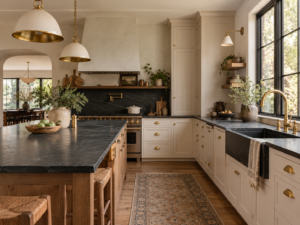
Soapstone deserves far more attention than it gets in Colorado. Soapstone is a natural metamorphic rock composed primarily of talc. It contains essentially zero crystalline silica, making it the safest option of any stone discussed here for the workers who fabricate it. It is non-porous and requires no sealing, is highly heat resistant, and develops a beautiful dark patina over time that many homeowners find deeply appealing. It is softer than granite and will show scratches, but those marks can be sanded out. Soapstone works beautifully in darker or more moody kitchen aesthetics and in historic homes where its material quality feels appropriate to the architecture. It is underused in Colorado and worth exploring.
Butcher block is worth serious consideration, particularly for homeowners who cook frequently and want warmth that no stone surface can match. Wood countertops have been used in kitchens for centuries for good reason: they are easy on knives, comfortable to work on, and develop a character over time that improves with use. Butcher block requires more maintenance than stone, regular oiling and the occasional sanding to address deep cuts or stains but that maintenance is straightforward and something most homeowners can do themselves. It pairs beautifully with stone countertops in a mixed approach: butcher block for the prep area, natural stone for the perimeter. It contains zero crystalline silica and is one of the most environmentally friendly countertop options available.
Large-format porcelain slab has improved dramatically in quality and availability over the past several years. These countertops offer a non-porous, heat-resistant, low-maintenance surface in an enormous range of aesthetics, including very convincing marble and stone looks. Porcelain does not contain the crystalline silica concentrations that make engineered quartz problematic for fabricators, and the finished surface is durable.
Sintered stone — products like Dekton — represents another manufactured category developed as a premium surface material. These products are made from a mixture of raw materials including glass, porcelain, and stone compressed under extreme heat and pressure. They are extraordinarily durable, available in large-format slabs, and have lower crystalline silica content than traditional engineered quartz.
What should Colorado buyers know when evaluating a home with quartz countertops?
Do not panic. The quartz countertops in the home you are considering are not a health issue for you as an occupant.
What is worth understanding is that buyer perception of quartz countertops may shift as this story develops over the next twelve to eighteen months. The gas stove conversation changed how some buyers and sellers thought about gas appliances even before any bans took effect in Colorado. The quartz story could have a similar effect on kitchen preferences over time, not necessarily a dramatic price hit, but a shift in what buyers view as premium and what they view as something they will eventually want to change.
At Legacy 100 Real Estate Partners, we will be watching this issue and incorporating it into the renovation and listing conversations we have with clients. A kitchen renovation is one of the largest investments a homeowner makes before selling. Understanding which materials are moving toward premium status, which are declining in buyer perception, and which represent real long-term value is exactly the kind of knowledge fifty years in this market gives you.
For now, the honest answer is: do not panic, do pay attention, and if you are planning a renovation, consider whether this is the moment to explore the natural stone alternatives that have always been beautiful — and are now more relevant than ever.
Our experience. Your legacy.
Related reading:
- Denver Home Repair Priorities: What to Focus on Before You List
- Colorado Wildfire Insurance in 2026: What Every Homeowner Needs to Know
- Getting Your Home Ready to Sell in Denver
- Why Your Neighbor’s House Sold for More Than Yours
- Home Staging Denver: Is Your Home Having an Identity Crisis?
External Links:
- California KQED coverage of the proposed quartz ban: https://www.kqed.org/news/12100477/california-regulators-unveil-plan-to-ban-new-quartz-countertops-amid-rising-worker-deaths
- California Department of Public Health engineered stone silicosis information: https://www.cdph.ca.gov/Programs/CPDIC/Pages/EngineeredStone.aspx