
Earnest Money?
One of the first questions I hear from buyers once their offer gets accepted is some version of this: “Wait, now I have to send how much money to who?”
That moment of mild panic is almost always about earnest money. And honestly, it makes sense that it catches people off guard. You just had the exciting moment of getting your offer accepted, and now someone is telling you to wire thousands of dollars somewhere within the next day or two.
So let’s slow down and answer the question properly. What is earnest money, how much do you need in Denver, and most importantly, how do you make sure you get it back if something goes wrong?
What is Earnest Money, Exactly?
Earnest money is a good faith deposit you make after your offer on a home is accepted. Think of it as your way of telling the seller: “I am serious about this purchase, and here is some money to prove it.”
It is not an extra fee. It is not a non-refundable deposit in most cases. When your transaction closes successfully, the earnest money is credited directly toward your purchase price at closing. In other words, it becomes part of the money you were already planning to pay.
What is earnest money in real estate terms? It is essentially the first real financial commitment you make after an offer is accepted, and it gets held in a neutral escrow account by a third party until closing.
In Colorado, that third party is typically a title company. The title company holds your funds in trust on behalf of both you and the seller until the transaction closes or is terminated. This is an important protection for both sides.
How Much Earnest Money Do You Need in Denver?
There is no state-mandated minimum or maximum earnest money amount in Colorado. The deposit is negotiated between buyer and seller, which means the right number depends on the specific situation.
That said, here are the general norms for the Denver metro area in 2026:
In most standard transactions, earnest money runs between 1 and 2 percent of the purchase price, with many deals landing somewhere in the $5,000 to $20,000 range depending on the price point and current market conditions.
Here is what that looks like in real numbers:
On a $400,000 condo in Capitol Hill, earnest money might run $4,000 to $8,000. On a $700,000 single-family home in Washington Park, you are probably looking at $7,000 to $14,000. On a $1,000,000 home in Cherry Creek, earnest money could range from $10,000 to $30,000.
In competitive situations with multiple offers, buyers sometimes offer 2 to 5 percent to make their offer stand out. A stronger earnest money deposit signals financial strength and commitment, which can be meaningful to a seller deciding between similar offers.
For lower-priced homes or some condos, smaller deposits in the $1,000 to $3,000 range are still common, particularly for buyers using certain loan programs designed to reduce barriers to homeownership.
Your agent will advise you on the right number for your specific situation, the property, and the current competition. There is no one-size-fits-all answer.
When Do You Have to Pay It?
This is where buyers are often surprised by the timeline.
In most Denver contracts, earnest money must be delivered within 1 to 3 business days after your offer is accepted. That is a short window, and it is a hard deadline. Missing it can give the seller grounds to terminate the contract.
Wire transfers and cashier’s checks are the most common payment methods. Title companies in Colorado have strict good funds policies that specify exactly what they can accept.
One critical warning that every buyer needs to hear: wire fraud is a real and growing problem in real estate transactions. Never wire funds based solely on email instructions. Always call the title company directly using a phone number you find independently, not one provided in an email, to verify the wiring instructions before sending any money. This one step has saved countless buyers from losing their entire deposit to scammers.
Always get a written escrow receipt confirming the amount received, the date, and the name of the escrow holder. Save this with your contract paperwork.
What Protects Your Earnest Money? Understanding Contingencies
What is earnest money without protection? Potentially just a gift to the seller. This is why contingencies are so important, and why Colorado’s standard contracts are actually quite buyer-friendly.
Colorado’s standard real estate contract includes several contingencies that protect your deposit if something goes wrong. As long as you act within the specified deadlines, you can typically terminate and get your earnest money back under the following circumstances:
Inspection Contingency: If the inspection reveals problems you are not comfortable with, you have the right to object, request repairs, or terminate within the inspection deadline. In most Denver contracts this deadline runs 7 to 15 days from acceptance.
Financing Contingency: If your loan falls through despite your best efforts, you can typically terminate and recover your deposit. Missing your loan commitment deadline, however, puts your deposit at risk.
Appraisal Contingency: If the home appraises for less than the purchase price and the parties cannot reach an agreement, you can generally terminate and get your money back.
Title Review: If a title search reveals ownership issues, liens, or other problems that cannot be resolved, you can terminate within the title review period.
The key in every case is acting within the deadlines. Colorado contracts are specific about when and how you must deliver written notice of termination. Missing a deadline by even one day can change whether your deposit is protected. Your agent’s job is to track every deadline and make sure you never miss one.
What Does the Colorado Contract Say About Disputes?
This is the section most buyers never think about until they need it, which is exactly why I want to cover it here.
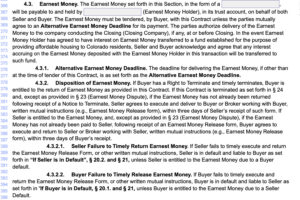
The Colorado Contract to Buy and Sell Real Estate addresses earnest money disputes specifically. Here is what buyers and sellers need to understand in plain English:
If you as the buyer have a right to terminate and you exercise that right properly and on time, the seller is required to sign the Earnest Money Release form within three days of receiving it. If the seller fails to do so, the seller is considered to be in default under the contract.
Conversely, if the seller is entitled to the earnest money due to a buyer default, and the buyer fails to execute and return the release form within three days, the buyer is considered in default.
The practical takeaway: both sides have obligations around the release of earnest money, and both sides can be held in default for failing to meet those obligations in a timely way.
What happens if the parties simply cannot agree on who gets the money? Under Colorado law, the escrow holder, typically the title company, cannot release the funds without either written agreement from both parties or a court order. This means a genuine dispute can result in funds sitting in escrow while the parties work toward resolution through mediation, arbitration, or in serious cases, litigation.
Most Colorado real estate contracts include a mediation clause requiring the parties to attempt resolution through a mediator before pursuing legal action. Mediation is far faster and less expensive than going to court and resolves the majority of earnest money disputes without litigation.
One genuinely interesting Colorado-specific detail worth knowing: if the earnest money holder has agreed to have interest on the escrowed funds transferred to Colorado’s affordable housing fund, any interest your deposit earns during the transaction goes to support affordable housing for Colorado residents. It is a small thing, but it is distinctly Colorado.
What Happens to Earnest Money at Closing?
Assuming everything goes smoothly, which it does in the vast majority of transactions, your earnest money is credited toward your total cash due at closing.
So if you put down $10,000 in earnest money and your total cash to close is $45,000, you would bring $35,000 to closing. The earnest money you already deposited makes up the difference.
In some cases, if the earnest money exceeds your closing costs, you may receive a small refund. Your closing disclosure will show you exactly how the numbers work out before you close.
Can You Lose Your Earnest Money?
Yes, and understanding exactly when puts you in a much stronger position as a buyer.
You risk losing your earnest money if you:
Cancel the contract after all your contingency deadlines have passed without a valid reason covered by the contract. Simply change your mind after deadlines have expired. Miss critical deadlines such as your loan commitment date or inspection objection period. Fail to deliver the earnest money on time in the first place.
The bottom line: your deposit is well-protected as long as you act within your contingency windows and meet your contract deadlines. Most buyers who lose earnest money do so because they missed a deadline or made a decision to walk away outside of their protected window. A good agent makes sure that never happens, which is why you need a seasoned broker who will protect you.
Earnest Money vs. Down Payment: What is the Difference?
This is a very common point of confusion, especially for first-time buyers.
Your earnest money is paid shortly after offer acceptance and goes into escrow. Your down payment is paid at closing as part of your total purchase funds. Your earnest money is applied toward your closing costs or down payment at closing, so it is not a separate additional expense. It is money you were already going to pay, just delivered earlier in the process.
They are not the same thing, but they work together as part of your total cash to close. (Read our complete guide to buying a home in Denver for first-time buyers ->)
A Quick Earnest Money Checklist for Denver Buyers
Before you make an offer, make sure you:
Know how much earnest money you are prepared to put down and have those funds liquid and accessible. Understand the contingencies in your contract and the specific deadlines for each one. Have your financing lined up so your loan commitment deadline is not a source of stress. Know exactly who will hold the earnest money and verify wiring instructions by phone before sending anything. Keep copies of every notice, receipt, and communication related to your deposit.
And above all, work with an agent who tracks every deadline proactively and keeps you informed every step of the way.
(Thinking about buying a home in Denver? Read our 2026 market update ->)
At Legacy 100 Real Estate Partners, protecting our buyers’ earnest money is something we take seriously on every single transaction. With 40 years of experience in Colorado real estate, we know these contracts inside and out and make sure our clients never miss a deadline or lose a dollar of their deposit unnecessarily.
Ready to start your Denver home search? Contact our team today ->
Sources and additional reading: